Before skincare came in elegantly designed packaging with scientific-sounding ingredient names, it was a craft. Knowledge passed from grandmother to mother to daughter. Preparations made slowly, carefully, with attention to every detail of process and ingredient. Among the most treasured of these preparations was a ghee cream washed one hundred times by hand — a labour of love whose results no modern formula has surpassed.
The Hundred-Wash Process: What Actually Happens
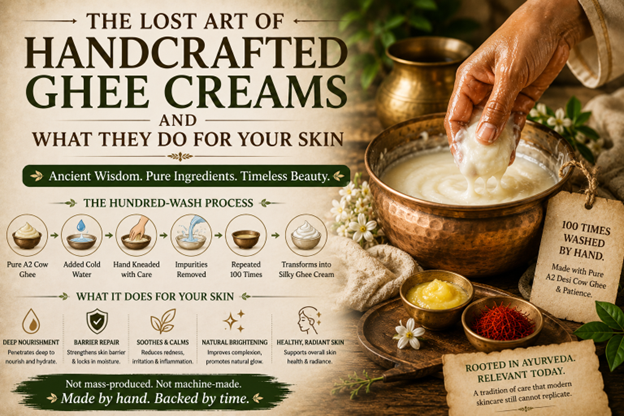
Creating an authentic 100 times washed ghee cream is a process that demands patience, precision, and the right raw materials. There are no shortcuts. The result depends entirely on completing every step with care.
The preparation process:
- Pure A2 desi cow ghee is placed in a clean copper or clay vessel
- Fresh cold water is added to the ghee
- The mixture is kneaded by hand until thoroughly combined
- The water — now carrying impurities and transformed compounds — is completely discarded
- Fresh cold water is added again and the process repeated
- This cycle is completed exactly one hundred times
What each wash progressively does:
- Removes residual milk solids that can clog pores or cause sensitivity
- Modifies the fatty acid chain structure at a molecular level
- Gradually shifts pH toward the skin’s own natural level
- Increases the bioavailability of fat-soluble vitamins A, D, E, and K
- Transforms the ghee’s consistency from dense and yellow to light and white
- Creates a lipid matrix uniquely suited to skin absorption
The Physical Transformation
The change from raw ghee to finished 100 times washed ghee cream is striking and measurable.
| Property | Raw Ghee | After 100 Washes |
| Colour | Deep yellow | Pure white |
| Texture | Dense and heavy | Light and airy |
| Feel on skin | Greasy, sits on surface | Absorbs quickly |
| pH level | Higher than skin | Close to skin pH |
| Pore impact | Can clog pores | Non-comedogenic |
| Vitamin access | Limited absorption | Highly bioavailable |
This transformation explains why 100 times washed ghee cream delivers therapeutic results that plain ghee applied directly cannot replicate.
Traditional Ayurvedic Uses
In classical Ayurvedic medicine, this preparation was prescribed for a wide range of skin and health concerns:
- Soothing eczema, rosacea, and chronic skin inflammation
- Healing wounds and supporting post-procedure skin recovery
- Calming heat-related discomfort and sun damage
- Nourishing dry, cracked, and weather-damaged skin
- Improving complexion and promoting natural skin radiance
- Protecting and strengthening the skin barrier during seasonal changes
Its versatility made it one of the most commonly recommended preparations in traditional Ayurvedic skincare.
Key Skin Benefits of Ghee Creams
Penetrates Without Clogging The modified lipid structure enters the skin’s deeper layers without blocking follicles. This is critical for those who have been told they cannot use rich creams because of acne-prone or oily skin.
Barrier Repair and Reinforcement The cream reduces transepidermal water loss — the invisible evaporation of moisture from the skin surface — and reinforces the skin’s protective layer against environmental stress.
Anti-Inflammatory Properties Butyric acid calms the chronic inflammation that underlies many common skin concerns including sensitivity, redness, and post-acne marks. Unlike steroid-based creams, it does this without thinning the skin or creating dependency.
Cellular Vitamin Delivery Vitamins A, D, E, and K are delivered in their most bioavailable form directly to the cells that need them, supporting repair, regeneration, and protection at the cellular level.
How It Works as a Brightening Ghee Cream
Among its many benefits, 100 times washed ghee cream is particularly valued as a brightening ghee cream. Its brightening action is multi-layered, addressing pigmentation from several directions simultaneously.
Brightening mechanism breakdown:
Step 1 — Accelerated Cell Turnover Vitamin A supports keratinocyte renewal, clearing away the layer of darkened, dead surface cells that make skin appear dull and uneven. This happens gradually and gently — without the irritation of synthetic retinoids.
Step 2 — Oxidative Stress Reduction Vitamin E neutralises the free radicals generated by UV exposure and pollution that trigger the skin to produce excess melanin. This prevents new pigmentation from forming while existing discolouration fades.
Step 3 — Post-Inflammatory Hyperpigmentation Control Butyric acid calms the inflammatory cascade triggered by acne, sun damage, friction, or any other skin trauma. This directly reduces the dark marks left behind after inflammation resolves.
Step 4 — Micro-Circulation Improvement Better blood flow to skin cells delivers more nutrients and removes waste products more efficiently, contributing to the kind of inner glow that no highlighter can convincingly mimic.
Unlike synthetic brightening ghee cream alternatives that achieve results through chemical inhibition — blocking enzymes, stripping layers, or bleaching pigment — this preparation works by improving the skin’s own healthy functioning. The results are more natural-looking, more sustainable, and free from side effects.
Why This Craft Nearly Disappeared
The decline of handcrafted ghee preparations reflects the broader story of industrialisation in food, medicine, and beauty.
Reasons for the decline:
- Chemical skincare became cheap and widely available in the mid-twentieth century
- Time-intensive preparation methods could not compete commercially with factory-made products
- Younger generations began associating synthetic with modern, effective, and scientific
- Traditional knowledge was rarely documented and passed on primarily through oral tradition
- The practitioners who carried this knowledge aged without finding successors
The knowledge survived in small pockets — dedicated Ayurvedic clinics, certain rural communities, and the memories of elders who had seen the results firsthand.
The Revival and What to Look For
A small number of authentic Ayurvedic brands are now reviving this preparation with integrity. When choosing a 100 times washed ghee cream, look for:
- Confirmation of A2 desi cow ghee as the base ingredient
- Transparency about the preparation process
- No synthetic preservatives, fragrances, or stabilisers in the ingredient list
- Cold-process preparation methods
- Minimal, recognisable ingredient lists
How to Use for Best Results
- Cleanse gently before application to maximise absorption
- Apply on slightly damp skin to lock in surface moisture alongside deep nourishment
- Use upward, outward strokes across the face and neck
- Apply a thicker layer overnight on areas of dark spots or discolouration
- Be consistent — use daily for a minimum of 6 to 8 weeks for visible brightening results
- Nighttime is optimal — skin regeneration is most active during deep sleep